



What's on this Page
Sign Up For FutureReady Updates
Questions about FutureReady can be directed to:
Students, families, and educators across Washington consistently report that current graduation requirements can be difficult to navigate and do not always reflect what students need to succeed after high school.
Through the FutureReady initiative, the State Board of Education is working to develop a proposal for updated graduation requirements that maintains strong academic expectations while creating more meaningful, flexible, and relevant learning experiences for students.
What the Draft Proposal Looks Like
The proposal is designed to create graduation requirements that give every student the opportunity to explore their interests, build real-world skills, and prepare for life after high school while supporting schools in offering relevant, authentic, and interdisciplinary learning opportunities. It also maintains strong academic expectations that keep multiple postsecondary options open as students’ goals evolve.
While the proposal is still in development, the Board and Task Force have reached consensus on several important changes to current requirements and identified several topics that still require further exploration and discussion. Please note that these items are not finalized and the final recommendation may differ from what is included here.
Better Support Student Postsecondary Planning by Improving the High School and Beyond Plan
Many students and educators feel that the High School & Beyond Plan is a checkbox exercise that doesn’t give them the time and support to meaningfully explore interests, set goals, and prepare for life after high school. We are working to create more dedicated time for this planning.
Streamline the Graduation Framework by Removing Graduation Pathways
Graduation pathways are widely regarded as an administrative hurdle that doesn’t effectively check whether a student has the knowledge needed to succeed after graduation. The proposal would simplify the framework by eliminating this requirement and give students and educators more time to focus on other areas in the graduation framework.
Expand Flexibility Aligned with Postsecondary Goals by Shifting Some Core Requirements into an Expanded Personalized Pathway Requirement
Under the proposal, some courses would shift into an expanded Personalized Pathway Requirement framework. Students will still be expected to take these classes unless they are ready to make an intentional choice to take other courses that would better prepare them to meet their post-high school goals. Additionally, high schools will still be required to offer all classes in expanded PPR requirements, ensuring that the change from a core requirement to a PPR doesn’t impact a student’s ability to access those courses.
This approach gives students more flexibility to pursue courses aligned with their interests, career goals, and postsecondary plans without lowering expectations or reducing academic rigor. Students who take all the recommended default courses in the PPRs would remain on track to pursue a wide range of postsecondary options, including four-year colleges, apprenticeships, military service, and workforce training programs.
Strengthen Math Preparation
The framework strengthens math expectations by requiring all students to complete coursework that prepares them with real-world quantitative skills. The proposal does this in two ways:
-
Ensure the default math sequence is aligned with college admissions expectations by setting the default third math credit to either Algebra 2 or Integrated Math III. For additional flexibility, a student may also satisfy the third math credit by taking Data Science, Statistics, or Financial Algebra.
-
Most students would be expected to take a senior-year quantitative reasoning course as one of the default Personalized Pathway Requirement courses.
Increased Emphasis on Civics
The proposal would consolidate the 0.5 credit Contemporary World History, Geography, and Problems (CWP) course and the 0.5 credit Civics course into a single 1.0 credit Civics course with CWP content embedded.
Integrate Opportunities for Instruction in Financial Education and Life Skills
The proposal would integrate opportunities for instruction in financial education and life skills into the credit framework. This responds to one of the most common requests from students and families who have consistently asked for more opportunities to learn financial education and life skills. Further discussion is required to determine whether this would be included as a course/content within the core subject requirement or as a PPR.
Create a Consistent Statewide Policy that Expands Flexible Credit Options to All Students
Students consistently express a desire for more hands-on learning experiences and greater flexibility in how they earn credits. While state law already allows school districts to adopt policies that meet the needs of these students—including competency-based crediting and Career Technical Education (CTE) course equivalencies—implementation is inconsistent across the state and existing CTE credit policies don’t always give students meaningful flexibility.
The Board’s proposal would address these concerns in two ways:
-
Establish consistent statewide policies for how students can earn competency-based credit, PE excusals tied to athletic participation outside school, and obtaining language credits as a multilingual learner. Creating statewide policies ensures that a student's location is no longer the determining factor in whether they can benefit from these policies.
-
Change the state’s CTE course equivalency policy by allowing students to earn two credits when a course allows a student to demonstrate competency in both the CTE standards and academic course standards. Under the current system, students can sometimes meet two subject-area requirements while earning only one credit, limiting flexibility within the 24-credit framework.
Definitions:
-
Core Courses: Must be completed by all students in order to earn a diploma. These courses must be offered each year by every high school.
-
Personalized Pathway Credits: Courses most students are expected to take that keep all postsecondary options open. Courses may be substituted on an individual student basis in alignment with preparation for a clear postsecondary plan documented in the High School and Beyond Plan and in consultation with a student's family and educators. These courses must be offered each year by every high school.
-
Elective Credits: Any High School level course (or college level equivalent) to allow for exploration, specialization, or enrichment.
Questions That We’re Still Working to Answer
-
How should a course about financial education be integrated into the graduation requirement framework, and should such a course include a focus on postsecondary planning for students (tying in a student’s HSBP)?
-
Should students be required to reflect on their learning and growth and demonstrate their readiness for their postsecondary goals in writing, through a presentation, or other creative product?
-
Should FAFSA/WASFA completion (with opt-out) be a graduation requirement?
-
Should all students be required to earn credits in physical education, art, and CTE in order to graduate (as a core subject requirement) or should students be able to substitute these courses with offerings that better align with their postsecondary goals (as a Personalized Pathway Requirement)?
How We Got Here & What's Next for FutureReady
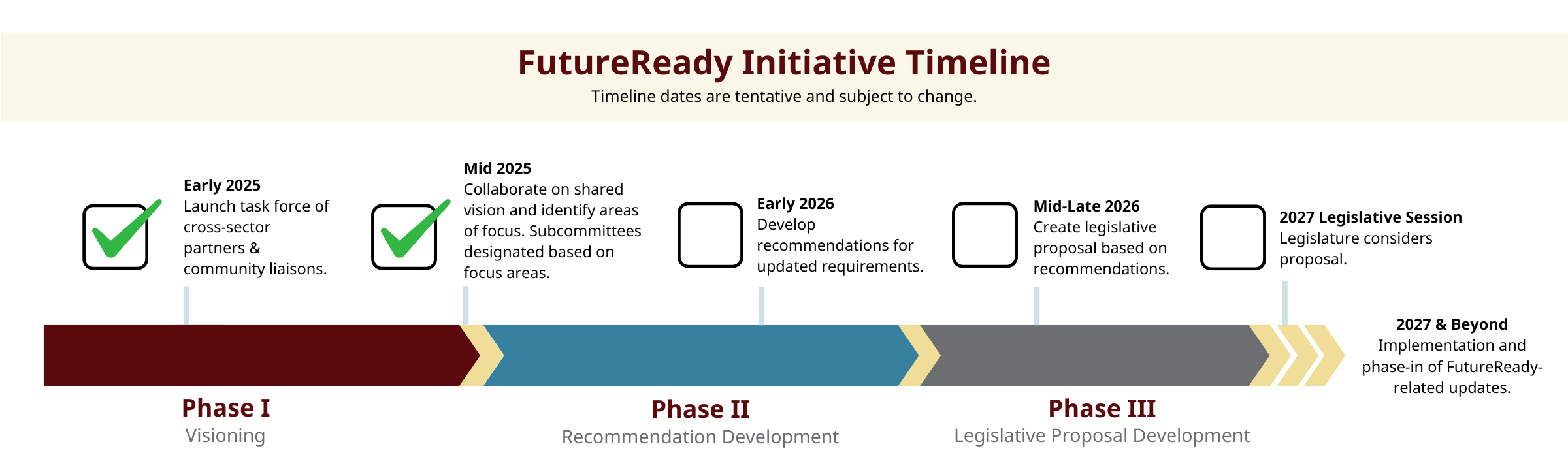
FutureReady launched in 2025 with a statewide task force made up of students, families, educators, employers, community organizations, and policymakers. The initiative is divided into three phases.
Phase I: Visioning & Gap Analysis
(Completed)
The Washington State Board of Education launched FutureReady to examine whether Washington's current graduation requirements prepare students for success after high school. Working with the FutureReady Task Force, the Board developed a shared vision for the high school diploma and identified gaps between that vision and the state's current graduation framework.
Phase II: Developing Recommendations
(Current Phase)
The Board and Task Force are collaborating with students, families, educators, employers, community organizations, and subject-matter experts to develop recommendations that address gaps identified in the system.
Draft recommendations will be shared publicly for feedback before any final recommendations are made.
Phase III: Legislative Proposal Development
(Starting Soon)
After reviewing public feedback, the Board will refine its recommendations and develop a legislative proposal for consideration during the 2027 legislative session.
Implementation Timeline
Any changes resulting from FutureReady would need to be finalized after the 2027 legislative session and some changes would require legislative action. The earliest new graduation requirements could apply would be for students entering ninth grade as part of the Class of 2031. Any approved changes may also be phased in over time to ensure schools have the support needed for successful implementation.
How Can You Get Involved?
Whether you're a student, parent, educator, employer, or community member, your input is invaluable. There will be opportunities for public comment and feedback throughout the process. Here are a few ways you can share your thoughts and stay up-to-date.

Give a Public Comment
Have something you want to say? Comments submitted using this form will be shared with the Board and may be publicly posted.

Subscribe to the FutureReady Newsletter
This is the best way to receive updates on the initiative and be the first to hear about important announcements.
Want to Learn More?
Read the FutureReady 2025 Interim Report
We are excited to publicly release the FutureReady 2025 Interim Report.
This report summarizes the work the Board and FutureReady Task Force have accomplished during their first year of work. It talks about why we’re updating requirements, our process for determining gaps in current graduation requirements, and what the next steps are as the FutureReady initiative prepares to develop recommendations.
We extend our gratitude to all the individuals and organizations who have supported our work over the last year. We look forward to continuing this work in 2026 as we develop recommendations for a high school diploma that prepares all students for success after high school.

Watch Our Presentation to Workforce Training and Education Coordinating Board
Board members and staff met with the Washington Workforce Training and Education Coordinating Board on April 3 to discuss the status of the FutureReady initiative, including an update on emerging elements of the framework, as well as the process that led to its development.

Other Resources
-
Download our FutureReady Phase II handout for an overview of the initiative, its timeline, and what kind of topics we're exploring.
-
Our FutureReady FAQ section answers many of the questions we've received about the initiative.
FutureReady Newsletters
June 10, 2026: Update on FutureReady Draft Recommendations for Graduation Requirement Updates
December 9, 2025: Announcing Our FutureReady Webinar and 2025 Interim Report
August 28, 2025: FutureReady Initiative Moves into Phase II - Starts Recommendation Development
June 4, 2025: A Recap of the FutureReady Task Force's May Meeting
April 2, 2025: A Recap of the FutureReady Task Force's March Meeting
February 12, 2025: A Recap of the FutureReady Task Force's January Meeting