



Contact
Alissa Muller
Director of Policy
The State Board of Education is responsible for setting state-level graduation requirements that students must complete in order to receive a diploma. The Board’s vision is that our state's education system should prepare all students for college, career and life. In support of this vision, the Board has worked to create high school diploma requirements that are both rigorous and flexible. In order to receive a diploma, students must meet credit and subject area requirements, graduation pathway option requirements, and have a High School and Beyond Plan. This page provides a brief overview of each requirement. For more information on specific requirements, please visit the requirement's webpage.
In addition to these state-level requirements, school districts may add additional local graduation requirements on top of the state minimum requirements. Districts could add additional credit and subject area requirements (e.g. a financial literacy course) or other requirements like a senior project or community service hours. Please contact your local school district for more information on any additional requirements.
Please note: Students are assigned an expected graduation year at the time they enter ninth grade (WAC 180-51-035). They are held to the graduation requirements of that graduation year regardless of the year they actually complete high school. To view graduation requirements by graduating class years, please reference the list of years below.
Credit Requirements
To graduate, students must complete a total of 24 credits — 17 core credits and seven flexible credits. This includes four credits of English and three credits of math, along with other subjects.
The 24-credit framework was designed to be both rigorous and flexible. High school course work for most students will keep all postsecondary options open, including meeting the college admission requirements for entry into a public four-year institution or pursuing a program of study in a two -year institution or apprenticeship. The framework is flexible enough to accommodate a program of study leading to a professional or technical certificate or degree through a skills center or Career and Technical Education program.

Key elements of the requirement framework:
-
7 of the 24 credits are flexible credits; these include 4 elective credits and 3 Personalized Pathway Requirements that are chosen by students based on their interest and their High School and Beyond Plans.
-
17 of the 24 credits are mandatory core credits, including 3 credits of science, 2 of which must be lab science.
-
2 of the flexible credits may be waived locally for individual students based on ‘a student's circumstances,’ as defined by local district policy.
-
Within some subject credit areas, students are required to receive credits from certain classes. For example, a student needs three social studies credits, but 1 credit must come from U.S. history, .5 credit from contemporary world history, .5 credit in civics, and 1 social studies elective. There is also a non-credit requirement for successful completion of Washington state history typically taken by students in middle school.

Graduation Pathways
In 2019, legislation removed the requirement that an individual student pass the state standardized assessments to graduate and replaced it with a set of graduation pathway options. The Legislature identified the graduation pathway options available for students. The Board is responsible for setting the scores on some of the test-based options.
The graduation pathway options provide students with multiple ways to show readiness for their individual education and career goals. The pathway a student completes must align with the student’s post-secondary goals as described in their High School and Beyond Plan.

Students must meet the pathway requirement in both English Language Arts (ELA) and mathematics, however they can do so through different pathway combinations. For example, a student might complete the ELA requirement through a performance-based assessment and the math requirement through a transition course. Students who pursue the ASVAB or CTE pathways do not need to meet English and math requirements separately since English and math are embedded in both of those pathways. School districts decide which pathways to offer, so access varies across and within districts.
Students must meet at least one of these pathway options to graduate (click on the item to learn more about that requirement):
High School and Beyond Plan
The High School and Beyond Plan (HSBP) is a personalized planning process that helps students – along with their families and teachers – navigate high school and prepare for their future. Each student starts their HSBP in 7th grade, and it’s updated every year to reflect their changing interests, goals, and needs.
The HSBP includes a high school course taking plan that aligns with a student’s postsecondary plans, any supports the student may need to graduate, an activity log that includes a student’s extracurricular experiences, and evidence the student has received financial aid information for postsecondary programs.
Click here to learn more about the High School and Beyond Plan.

Graduation Requirement Resources
Graduation Requirements 101 Handout
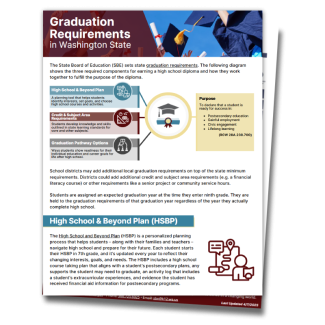
This helpful one-page brochure highlights the three required components for earning a high school diploma and how they work together to fulfill the purpose of the diploma.
Download the Handout in English
More Graduation Requirement Resources
